Why the business is losing millions: the case of a vessel blocked at the port by the State Inspectorate


In our previous publications, we have repeatedly stated about the difficulties business had encountered in its interaction with the Environmental Inspectorate. We have to go back again, analyze, predict and figure out what is the catch. Why nothing has changed over the past year?

In the first article, we covered one of our cases and revealed step by step how ecologists skillfully replace concepts and how much this “creativity” of government officials costs the business.

Since the publication of our first article one year has passed. However, the situation with the stopping of ships by ecologists was not improved. On the contrary, it has become much more widespread. What is the most interesting, the scheme has not changed at all, only small nuances have appeared. In the press, as before, there is no mention of the facts of illegal stopping of ships and gross violations of environmental laws by ecologists. Due to the fact that a year later the client turned to us with a painfully familiar concerning the problem with stopping the ships, we decided to dedicate the article to this problem again.

So, we will lay it out in order. Our client acted as the grain cargo owner and after loading onto the ship the seal “radiological monitoring the import/export is prohibited” magically appeared again on the bill of lading stamped by employees of the State Environmental Inspectorate. The ship was stopped in the port, the customs authorities refused to accept the cargo noting that it did not pass radiological control.

In our case, the grain was the cargo. According to the current legislation, this type of cargo is not subject to environmental monitoring at the customs, if the checkpoints have automated control systems for the transportation of radioactive substances and nuclear materials. Radiological monitoring of such products is carried out only if they begin to emit the radiation, passing the “frame”. In case the cargo in the port has successfully passed the automated control complex – the “frame”, it means that goods are not radioactive and, therefore, no claims can be made on the issue of cargo’s radioactivity. After passing the frame, the cargo is loaded onto the ship, waiting for its shipment.

Our client’s cargo successfully passed the “frame” in the port, therefore, ecologists had no reason to conduct radiological monitoring. However, despite this, exactly as in the previous case, the environmental inspectorate puts the “radiological monitoring import/export is prohibited” stamp on the bill of lading without any legal basis.

The cargo owner is in a panic, because he does not understand why a sign of prohibition the export due to the non-passage of radiological monitoring has appeared on the bill of lading as he successfully passed the automated control during loading. Also, the shipowner makes a complaint to the cargo owner and accuses of detaining the vessel, since according to official documents it was the non-passage of the radiological control of goods caused the detaining of a ship. Therefore, all the losses the shipowner is trying to give to the cargo owner.

As a year ago, only after the official appeal of the cargo owner to the State Ecological Inspectorate with a request, what was the basis of putting a stamp of the non-passage of radiological monitoring, things began to clear up. It turned out that the State Environmental Inspectorate does not have any claims to the cargo again, and the export ban was stamped on the bill of lading on the basis that the vessel violated the environmental legislation. According to the supervisory authority, the ship polluted the country’s sea waters.

The State Environmental Inspectorate’s response gave grounds to say that everything was all right with the cargo, but proposed no solution to the main problem – the vessel continued to remain in the port and both the cargo owner and the shipowner suffered huge losses.

We have already described the “creativity” of the environmental inspection. We revealed how ecologists delicately replace concepts with only one purpose – so that the customs would not have the right to sail a ship from Ukraine. Surprisingly, but over the past year, nothing new in this “scheme” of stopping ships has been introduced. Probably, there is no need, because during the year everything works fine, but about the consequences for the economy of Ukraine to say the least of it of “illegal”, actions we will tell later. Now, recall how everything works.

There are several types of controls that the State Environmental Inspectorate performs in Ukraine. The first is radiological. Formally, it was carried out in our case and was applied to the cargo. The second is the environmental monitoring of the vessel, which has nothing to do with radiological monitoring. Its non-passage in no way should be displayed as a “radiological monitoring the import/export prohibited” stamp put to the bill of lading of the cargo owner.

According to the regulations, the State Environmental Inspectorate had the right to check the territorial and marine waters for compliance with the standards for maximum allowable concentrations of pollutants. Such check is possible only if during the discharge from the vessel of isolated ballast, visible floating parts are thrown out with it, or visible traces of oil, oil-containing or other pollutants occur in the discharge area.

In our first case, the goal was to stop the ship’s departure. So, the environmental inspectorate conducted a survey of ballast discharge near the vessel for no visible reasons. Then the inspectors in the presence of the port representative drew up the water sampling report. Based on the above act, state officials compiled a protocol for measuring the indicators of composition and characteristics of the waters, and in the selected water samples they “found” an excess of the boundary norms of iron and oil products.

Have a question?
Ask
a specialist!

This is a “standard” scenario “successfully” applied to the majority of ships entering the ports of Ukraine. According to the current legislation, after creating the act, ecologists had the right to draw up only a protocol on administrative violation as well as to calculate the losses caused by the ship to the environment. However, everything is different. In most cases, after such an act the State Environmental Inspectorate put a stamp of the non-passage of radiological control by the cargo on the shipping documents. It should be noted that the presence of such a stamp was an iron foundation for the refusal of customs authorities in passing the customs and sailing the ship from the port.

The stories about stopping the ship had different endings. Some of the shipowners received an administrative fine for an administrative violation for a couple of hundred hryvnias and that is all. Someone had to pay the losses calculated by ecologists amounted to hundreds of thousands hryvnias. Then the ship was also sailed. However, in some cases, as in our last, everything was even worse.

No one presented to the shipowner neither the water sampling report, nor the protocol for measuring the indicators of the composition and characteristics of the waters. There was no fact of the offence by the vessel. There was only a “radiological monitoring the import/export is prohibited” stamp on the bill of lading and the week of detaining the ship with a total loss of more than 150 000 USD.

During this week, both the shipowner and the cargo owner received anything except the letter of ecologists addressed to the marine agent about the facts of water pollution, their non-admission to the ship, measurements and so on. When dozens of requests were made and complaints were filed to all possible instances – the ship was simply released. When asked what became the basis for stopping the ship, ecologists in their official responses admit without hesitation, that the environmental inspection does not have another tool to detain the ship, that’s why there is a stamp applied that specifically refers to the radiological control.

The position is very interesting, most importantly is that officials openly admit that they are rudely violating the current legislation, exceeding their authority and deliberately cause business losses. According to the information published by the Office of Effective Regulation on their Facebook, it is said that business losses from illegal actions of the State Environmental Service using the stamp “radiological monitoring the import/export is prohibited” exceed 200,000,000 dollars a year. That’s not counting daily losses of the staying the ship and cargo in the port, which range from 15 to 30 thousand dollars a day.

The most interesting thing in this situation is that since the groundless stops of the ships in the ports have become widespread, not a single inspector or his supervisor involved in illegal actions has been brought to justice. There was not even a fact of disciplinary responsibility or a banal reproval, no more serious consequences as dismissal or criminal liability. Despite the fact that there were such appeals, but they were deliberately blocked at the Environmental Inspectorate management level.

We can’t anticipate that problematic issues with the state environmental service will be resolved with the adoption of the new Law of Ukraine №2530-VIII from 09.06.2018 “On Amendments the Customs Code of Ukraine and some other laws of Ukraine regarding the adoption of a “single window” facility and optimization of the implementation of control procedures for the movement of goods across the customs border of Ukraine“. Although, according to ecologists, this Law that deprives them of their authority and with its adoption they will not be able to carry out environmental and radiological monitoring of goods and vehicles moved across the customs border of Ukraine.

We studied the new Law several times very carefully, but we did not notice any obvious changes in the powers of ecologists. The legislator slightly modified the definitions in the old and new editions, but we did not see a direct ban on putting the “radiological monitoring import/export is prohibited” stamp. In addition, ecologists did not have the right to carry out the above actions in the laws of the previous edition. The exceptions were cases with the automated control frame in the port. However, nothing and nobody prevented government officials from using this stamp, even in cases not prescribed by law. After the adoption of the new Law, information began to appear in the press that the vessels in the ports continue to stop.

In fact, only the technology has changed a little now. For example, instead of putting a stamp “radiological monitoring import/export is prohibited”, ecologists decide to ban the ship from leaving the port. Although they have such a right only in one case (as before), if the cargo emits the radiation and this fact is established by the Customs authorities.

Doesn’t that remind you of something? All the same, only under a different sauce. In fact, the promised changes about minimizing abuses by the State Environmental Control did not happen. The mechanism of the scheme has changed. The issue of bringing to responsibility public officials involved in the illegal stopping of the ship and cargo and recovery of the business losses remains open. Until the above practice and clear position of the business is formed, the system will continue to work as it has worked, even with slight changes.

As always, the final choice should be taken by the business.

Liked the article?

Name: Mykola

Surname: Siutkin

Email: siutkin@sp.agency

Phone: +380443830000

Company address: 10 Redutnaya Street, Kyiv, Ukraine


Send a message

As long as businesses are willing to lose money, the system will not change


Over the past year, business losses due to illegal actions by the State Environmental Service have amounted to $200,000,000. The co-founder of S&P Investment Risk Management Agency, PhD, MBA, risk management business advisor, and attorney Natalia Osadcha explains how the scheme of stopping ships in ports operates.

We have repeatedly discussed the difficulties of business “interactions” with the Environmental Inspection in previous publications. Using one of our cases as an example, we detailed step by step how environmental officials skillfully and subtly manipulate terminology with a single goal – to prevent a vessel from leaving a Ukrainian port. A full year has passed since the publication of our first article. Unfortunately, no positive changes have occurred during this time. Once again, we must revisit the issue, analyze, forecast, and investigate where the real problem lies. The irony is that, a year later, a client has approached us again with a painfully familiar problem – a vessel being detained in port.

Our client is the owner of a grain cargo. The ship was detained in port because a stamp reading “Radiological Control: Import/Export Prohibited” mysteriously appeared on the bill of lading. It is important to note that under current legislation, this type of cargo is not subject to environmental control, and radiological control is conducted only if the cargo exhibits radiation emissions. Our client’s cargo successfully passed through the automated control system in the port. Nevertheless, without any valid grounds, the State Environmental Inspection stamped the bill of lading with “Radiological Control: Import/Export Prohibited,” indicating that the cargo was radioactive and that the vessel carrying such cargo could not leave the port.

Just like a year ago, it was only after the cargo owner officially contacted the State Environmental Inspection that the situation started to become clearer. It turned out that the Environmental Inspection had no claims against the cargo itself. Instead, the prohibition stamp was placed on the bill of lading based on allegations that the vessel had violated environmental protection laws. According to the regulatory authority, the ship was polluting the country’s internal waters. Despite the cargo being in perfect order, the vessel remained detained in the port, causing massive financial losses for both the cargo owner and the shipowner.

If environmental officials had acted within the framework of existing legislation, they would have issued an administrative violation report and calculated the environmental damage caused by the vessel. However, they had no legal right to detain the ship in the port.

In reality, the shipowner was never presented with a water sampling report, a protocol of water composition and characteristic measurements, or any official documentation confirming the vessel’s violation. There was no record of an offense committed by the ship, no administrative violation protocol, no fine, and no calculation of damages. The only thing issued was the stamp “Radiological Control: Import/Export Prohibited” on the bill of lading, resulting in a one-week delay and total losses exceeding $150,000.

Have a question?
Ask
a specialist!

In response to official inquiries about the reason for the ship’s detention, environmental officials shamelessly admitted that the Environmental Inspection simply had no other mechanism to detain a vessel, so they resorted to using a stamp intended for radiological control of goods.

The illegal actions of officials have catastrophic consequences. According to information published by the Better Regulation Delivery Office (BRDO) on Facebook, the estimated business losses due to the unlawful use of the “Radiological Control: Import/Export Prohibited” stamp by the State Environmental Service amount to approximately $200,000,000 per year. This figure does not even include the daily losses from vessel and cargo downtime, which range from $15,000 to $30,000 per day.

The situation was expected to improve with the introduction of Ukraine’s new Law No. 2530-VIII, adopted on 06.09.2018, “On Amendments to the Customs Code of Ukraine” and certain other laws regarding the implementation of the “single window” mechanism and the optimization of control procedures for goods crossing Ukraine’s customs border. Unfortunately, the law only made minor adjustments to how environmental officials operate, without changing the final outcome—ships continue to be unjustifiably detained in ports. The only difference is that instead of stamping “Radiological Control: Import/Export Prohibited,” environmental officials now issue direct bans on vessels leaving the port. However, they are only legally permitted to do so in one specific case—if the cargo exhibits radiation emissions (exceeding permissible radiation levels), as determined by Customs authorities.

Regarding our case, we made every effort to secure the release of the vessel. The issue of holding government officials accountable for the unlawful detention of the ship and cargo, as well as recovering damages from them, remains unresolved. Until a precedent is established and businesses take a firm stance, the system will continue to operate as it has, with only minor adjustments. Ultimately, the choice remains in the hands of businesses—just as it always has.

Liked the article?

Name: Mykola

Surname: Siutkin

Email: siutkin@sp.agency

Phone: +380443830000

Company address: 10 Redutnaya Street, Kyiv, Ukraine


Send a message

Mykola Siutkin: Proper formalization of business relationships is the key to minimizing corporate conflicts


Mykola Siutkin, CEO and founder of S&P Investment Risk Management Agency on why the flow of foreign investments has not yet flooded the country with such a rich potential and on the peculiarities of doing business in Ukraine.

S&P Investment Risk Management Agency specializes in creating complex solutions for the business protection sphere. Mykola Siutkin shares his experience with Boryspil magazine and insists that only integrated approach can be effective in protecting business interests.

Doing Business ranked Ukraine 76th in 2017. What is your forecast for the FDI growth in 2018?

M. Siutkin: A positive change in ratings means that Ukraine can easily become visible. Investors approve decisions after analyzing the business environment and risks. Ratings can’t force an investor to come to a country where business is suffering from raiding and state authorities’ illegal actions. It is essential that the state image be shaped and that examples of successful investments be shown while creating clear business conditions for foreign investors.

What risks do foreign investors take in Ukraine? Can they avoid those risks?

M. Siutkin: Loss of investments and/or assets is a risk. The second essential point includes conflicts with Ukrainian partners, which can lead to loss of assets and/or business. The third critical group of risks includes conflicts with the state authorities.

Have a question?
Ask
a specialist!

Risk issues are deep enough, we even have a training for CEOs on avoiding or minimizing risks.

Which tools for protecting investors are effective?

M. Siutkin: We use GR, PR, Crisis Communications, Crisis Management, Coaching, Mentoring, Management and Legal Instruments while protecting business. They are matched according to the task complexity. It is a multi-level process developed for each case individually. The legislation provides enough tools for protection, the point is the ability to use them properly.

What would you recommend an investor who starts a business in Ukraine?

M. Siutkin: I would recommend acting legally, regardless of imposing ways of cheating by anyone. There are many successful entrepreneurship examples in our country – honest, transparent and legal. Such a strategy is more rational from the financial point of view.

What would you recommend investors regarding building partnerships?

M. Siutkin: A partnership is successful only in case of creating a proper system of checks and balances, which will restrict agreements violations by one of partners. Having a reasonable approach to building partnerships is the key to minimizing corporate and/or raider conflicts. According to our analytics, mistakes of partnerships formalizing are main causes of losing assets in 95% of cases.

Liked the article?

Name: Mykola

Surname: Siutkin

Email: siutkin@sp.agency

Phone: +380443830000

Company address: 10 Redutnaya Street, Kyiv, Ukraine


Send a message

15th Kyiv Post CEO Breakfast: ‘Ukraine’s Road to Prosperity’


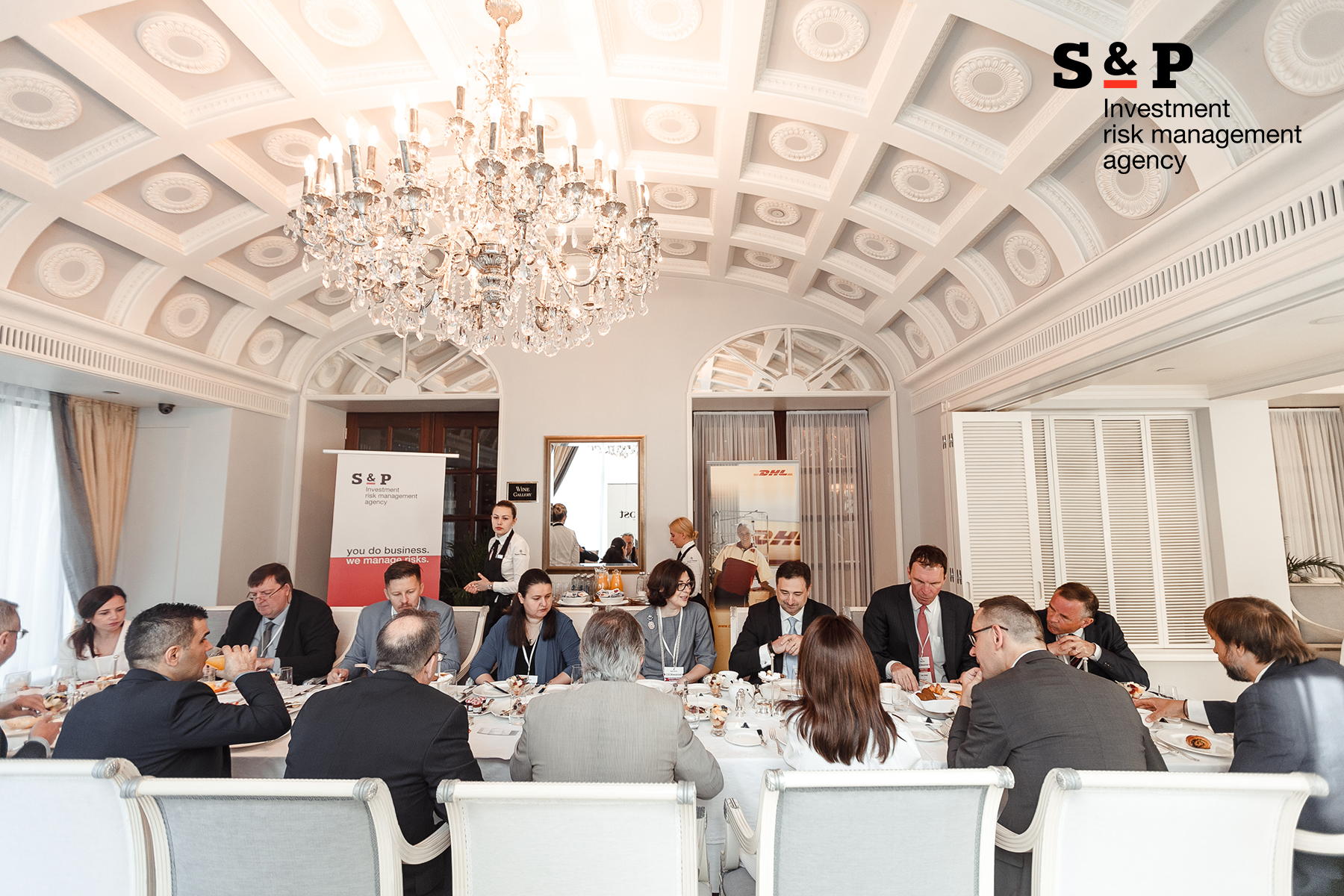
On 10 July, the 15th Kyiv Post CEO Breakfast was held at the InterContinental Kyiv. The event was organised by S&P Investment Risk Management Agency and DHL Express Ukraine.

The topic of the meeting was Ukraine’s Road to Prosperity. The participants discussed the need to create a fiscal investigation service, the effectiveness of the anti-corruption court, gas prices, subsidies, creating an effective anti-smuggling mechanism and other pressing issues.

Business representatives have noted noticeable improvements in the banking sector. After many years of crisis and financial losses, today we can talk about increased liquidity and, in the long run, the empowerment of creditors.

In addition, they raised the issues of raising the property tax, restrictions on transfer pricing abuse, the legal status of the tax police, and the thorny issue of eradicating corruption at customs and in other areas of the public and private sectors.

Have a question?
Ask
a specialist!

Talking about our country’s path to prosperity, the participants of the 15th CEO Breakfast, under the auspices of the Kyiv Post, came to the conclusion that Ukraine is a worthy country for investment, which has every chance of success. Unfortunately, positive changes are happening too slowly in our country. Ukraine has enormous potential that can be realised if the business climate is favourable and the necessary reforms are implemented. At the moment, unfortunately, direct investment in Ukraine remains negligible.


Liked the article?

Name: Mykola

Surname: Siutkin

Email: siutkin@sp.agency

Phone: +380443830000

Company address: 10 Redutnaya Street, Kyiv, Ukraine


Send a message

Nataliia Osadcha: “Business conflict, what is it or how to turn a minus into a plus”


Interview of Nataliia Osadcha, co-founder of the S&P Investment Risk Management Agency, PhD, MBA, on the role of conflicts in the life of big business

It’s no secret that Ukraine is a country of risky investments. Prosperous corruption, lack of sufficient protection of private property rights and many other prerequisites create fertile ground for the development of business conflicts. Today’s trend in the country is the involvement in such conflicts a large number of participants, including state and law enforcement agencies, but there are those unicums, who could resolve the conflict and withdraw the company from it.

LDaily turned to Nataliia Osadcha, the co-founder of a company, the S&P Investment Risk Management Agency, which is specializing in minimizing conflicts and rescuing business from conflicts of any complexity. In her interview, Nataliia talked about what business conflicts are, what consequences they have for the business, about the strategy to get the business out of conflict, what tools to use and what bonuses the business gets when it successfully stops the conflicts.

LD: Natalia, tell us what is «conflict» in your understanding. And what kinds of conflicts exist today?

N. Osadcha: Conflict, business conflict, is a term that we have started applying in our practice long time ago. So, we realized that many serious problems in business do not happen under the specificity of corporate conflicts, and also can not be identified as raiding. We also found that such a phenomenon as corporate raids and corporate conflicts have undergone such significant changes, have merged so much with other forms and interests that they can not already be attributed to some known classical forms and/or classifications. For us we started to usethe term “conflict” which is much wider than the above definitions and, of course, it includes all the types of conflicts that exist today.

According to our definition:

conflict means any situation that leads to different types of losses for business.

Today in Ukraine there isa huge number of conflicts` types, including external, internal, involving government agencies, with the participation of partners, competitors, employees, former employees and so on. It is possible to enumerate them for a long time, we even derived our classification of conflicts` types, which we present in our trainings for the CEO.

Nowadays there are no conflicts in the pure form – internal or external conflicts, and it does not even matter who initiated them, but what is important is that 95% of all conflicts are carried out with the participation of the state and / or law enforcement agencies, and with such participation the conflict goes to another level.

The main problem is the wrong identification of the conflict. For example, in 90% of companies` cases their consultants do not identify the situation as a “conflict”, they assign it the status of “problem”, which refers to the standard business operations. In this regard, the following mistakes occur: the strategy, instruments are incorrectly defined as well as the ultimate goal of the conflict, its possible timing, risks associated with such a conflict areincorrectly identified and also possible losses that the company may incur, their types and size.

LD: What should do a company that turned out to be in serious conflict?

N.Osadcha: Any conflict for the company is always difficult. It is difficult because sometimes this is the first experience of this kind for the company. And, as I said, to understand and correctly identify the conflict at an early stage is a guarantee that the company will avoid “deep diving” and as a result minimize the terms of the conflict, risks and all kinds of possible losses for business.

We have specially developed a number of trainings for CEOs and / or business owners, especially with the goal of teaching to identify correctly the conflict, showing and detailing the business, which may indicate that the company is already in conflict.

I will give an example from another area of life, which at first glance is in no way connected with business processes, but it very eloquently shows, how important the correct diagnosis is. For example, a patient comes to a consultation with a doctor who, after examination, diagnoses a patient with SARS, and prescribes treatment according to the diagnosis. Of course, such treatment will not bring relief, moreover, worsen the patient’s condition. But if the doctor had carried out a complete examination of the body, he would have seen that a patient’s coughing was a consequence of pneumonia. That is, what he sees and hears is a consequence of something very serious and protracted. With business can happen the same and that’s why the business often loses because it incorrectly identifies the situation, as a result a company builds a strategy improperly , uses the wrong tools, and, accordingly, adheres to the firstly chosen wrong motion vector.

LD. What tools should the business use to overcome the conflict as a winner?

N.Osadcha: Our company has been engaged in breaking the business out of conflicts for more than 10 years, S &P’s partners have been doing this all their lives for more than 20 years. We have had a long way to this, by attempts and errors and realized that withdrawing a company from any conflict using only one or two tools is impossible.

Some companies make the main bet on legal instruments, others put PR at the forefront, while others think that only GR will help them to get out of a difficult situation. We disagree that the choice of tools, their frequency (at what stage to use), main messages must be closely intertwined and built into a single strategy.

In the process of conflict development, both the strategy and the initially selected set of tools will change. Applying only one tool or deliberately building a strategy around it only reminds me of a picture when a military general wants to win a war only with help of one type of weapon, for example, a spear, although the enemy’s arsenal consists of infantry, tanks, aviation and even the fleet.

Have a question?
Ask
a specialist!

There must necessarily be a comprehensive strategy, including – PR, GR, a combination of time and messages. Of course, without a legal instrument it is impossible to get the company out of the conflict, especially if the level of complexity is high. But only a certain set of tools works in a certain percentage and with certain messages aimed at a certain result.

Unequivocally I can say that only due to such anapproach S&P Investment Risk Management Agency succeeds in successfully removing business from serious and protracted conflicts. Our successful cases are an indicator of the effectiveness of the developed strategy and selected tools.

LD: Can you give examples of different types of conflicts from your practice?

N.Osadcha: We do not have the right to disclose the cases with the names of the persons involved in the conflict, but I can cite isolated examples of different types of conflicts. So, there can be an internal conflict between partners. For example, one of the partners received (formal or non-official) control over the executive body and in fact exercised sole control over the company; he also subordinated financial flows to himself. Regarding to the second partner, the options in this case may be different, from the legal deprivation of the last ownership of the business, to bringing charges and removing it from business management.

Internal conflict, like any other, does not exist in its pure form any longer, but is always closely intertwined with the government. Sometimes the problems of one of the partners begin with the state bodies, and only in the process of conflict development it becomes clear who is behind it and who initiated the conflict.

There are external conflicts when a competitor in the market carries out illegal actions against another player of the market, sometimes only for the sole purpose of gaining market share and customers of his opponent. Such conflicts often “start” with an application for a crime filed by a competitor, and of course, such conflicts are also carried out with the participation of both government and law enforcement agencies.

LD: So we can say that the Conflict is very much similar to military actions. How do you think, if it is possible to talk about the similarity of such phenomena?

N.Osadcha: The similarity is very high, moreover, the term “war” is often used in the context of corporate conflicts. Very often they are called “corporate wars”. Any conflict is a “military action” in miniature. There is also an interested person, there is an ultimate goal of the conflict, there is a strategy of opponents and as in the war, everything changes very quickly depending on the actions of the opponent. Why else can you compare conflicts with the war, since the ultimate goal is very often either a business as a whole, or a valuable asset, or a significant market share, or financial flows. And this, in fact, is the vital artery of business. Therefore, the strategy of getting out of such a crisis for business should be very measured, systematic with the use of the right tools and exclusively within the legal field of Ukraine.

Also I want to draw attention to the fact that the right way out of the conflict will bring enough serious bonuses for the latter. We even gave this phenomenon the name “how make a plus from a minus for business”. At our training we indicate what “advantages” the business can get from the conflict. As an example, we can talk about forming a reputation component, both among the business community and in relation to the government. Also, the company gets immunity for possible conflicts in the future.

In fact, the conflict can give a lot of “pluses”, you just need to work on it.

LD: Why did S&P Investment Risk Management Agency choose for itself a specialization in breaking the business out of conflict as the main one?

N.Osadcha: We deliberately devoted ourselves to protecting business. We began our activity in 1998 when large investors just started to enter Ukraine. And, in fact, we spent a huge amount of time and gained invaluable hands-on experience. We got a unique chance to do what we like, do what we believe. I also believe in highly specialized professionals, regardless of the scope of their activities.

The problem of Ukraine is that many people try to offer everything, for example, if you go to a restaurant, very often you will find the menu line from sushi to borsch. But it is impossible to be good in everything: either you have spent your life on something exact, and then you are a professional in this issue, or you are everywhere and in a little bit, but in fact nowhere.

Working as a strategic business consultant, especially in such areas as conflicts, places the latter fully responsible for assets, investments, and sometimes for business in general, including the personal freedom of its owners.The responsibility is very high, as are the rates in such conflicts. Therefore, it will be an effective consultant who has strong practical background. I am sure that today S & P company corresponds to what it declares, and I’m glad that I’m a part of such a unique team of its kind.

Exclusively for LDaily

«S&P Investment Risk Management Agency» owns the exclusive copyright of the information in this article. The author has the sole right to control the use of this material. It means the prohibition of using this information without our consent. The term “information” means texts, comments, photos, images, and other materials. Any use of the information or any part of this article without the written permission of the author is prohibited. The term “use” means copying, adaptation, re-writing, modifications, etc. In the case the irregularities are detected, the author has the right to copyright protection in accordance with the procedure established in Article 50-53 of the Law of Ukraine «On Copyright and Related Rights».

Liked the article?

Name: Mykola

Surname: Siutkin

Email: siutkin@sp.agency

Phone: +380443830000

Company address: 10 Redutnaya Street, Kyiv, Ukraine


Send a message

A Single Account for Customs Payments Started Functioning


From April 16, all customs clearance of enterprises’ goods will be carried out solely through a single account.
The introduction of a single account was foreseen by the Procedure for transferring customs and other payments to the state budget entered into/during the customs clearance, which came into force on December 19, 2017.

The new procedure for transferring payments to the customs budget should reduce the time of customs clearance of goods, since the funds will be accounted for in one card – a personal account of the subject of foreign economic activity. Such innovation is welcomed by the business, as there will be no need to submit several declarations to different customs offices, to transfer funds to various customs, which had different accounts before.

Have a question?
Ask
a specialist!

From now on, all customs will have a single account and declarations will be served in any customs office.

Nearly two years have passed since the adoption of the relevant resolution, but according to the SFS, a separate unit has been set up to ensure the functioning of a single account,
modern software for direct communication between the SFS and the Treasury has been developed. This is done to control funds both during the process of receiving funds from enterprises and during transferring funds to the budget.

Liked the article?

Name: Mykola

Surname: Siutkin

Email: siutkin@sp.agency

Phone: +380443830000

Company address: 10 Redutnaya Street, Kyiv, Ukraine


Send a message